
We asked Google's AI Mode how many pools The Mulia in Bali has. It listed six, then illustrated the Oasis Pool, the resort's signature beachfront pool, with a public swimming pool of the same name in Las Vegas. In the same week it gave SOF Hotel, a 45-room design hotel in Taichung, 39 rooms, in three languages, and quoted its rates at a third of what the hotel charges. For independent hotels in Asia, that is the short answer to the AI search question: your website decides whether these engines get your facts right, and your Google Business Profile, your OTA listings and your pages in each guest's language decide whether they recommend you at all.
We know both hotels well, which is why we could catch the mistakes. Artehos Concepts builds hotel websites and brands, and I spent 15 years inside hotels before that, so we set up the test the way a guest actually uses these tools: plain questions, in their own language, from where they live.
What we asked, and where from
Between 25 and 26 September 2026 we put the same guest questions to Google AI Mode, ChatGPT, Perplexity and Gemini: 171 answers in total. Most were discovery questions ("best luxury beach resort in Nusa Dua", "design hotel near Taichung Station", "honeymoon hotel with a big pool on the beach"), the rest were fact questions about each hotel (rooms, pools, distance to the airport or station, what guests complain about). We asked in English, then in the languages the two hotels' guests actually speak: Chinese and Korean for The Mulia, Japanese and Korean for SOF. Most runs came from Singapore; we repeated the Japanese and Korean sets from Tokyo and Seoul.
| Google AI Mode | ChatGPT | Perplexity | Gemini | |
|---|---|---|---|---|
| Answers collected | 84 | 50 | 34 | 3 |
| Where the facts came from | Business Profiles, OTAs, Facebook, YouTube, blogs | the hotel's site or an official register, mostly | the hotel's site | not shown |
The Mulia is a large beachfront resort in Nusa Dua with three wings (The Mulia, Mulia Resort and Mulia Villas) and more than 700 keys; it is an Artehos client. SOF Hotel is a 45-room independent design hotel in Taichung's old Central District, ten minutes' walk from the station; it is not.
Google's AI reads everyone except you
Google AI Mode got the facts wrong or contradicted itself in 11 of its 20 fact answers. The Mulia's pool count swung between four and six. Its distance from the airport came out as 12.8 km, 13 to 15 km and 14.6 km (Gemini added 9.6). SOF was priced at US$41 to 53 a night in English and 50,000 to 80,000 won in Korean, when rooms start at US$132 on its own site. One answer described a breakfast dress code The Mulia does not have.
The pattern behind the errors is where AI Mode reads. In our answers it built hotel facts from Google Business Profiles, Agoda, Trip.com, Expedia, a single Facebook page that posts resort reviews, and YouTube tours. It cited The Mulia's own website in 5 of its 84 answers, none of them in English. ChatGPT and Perplexity went the other way: when they answered a fact question, they mostly quoted the hotel's site or, in Taiwan's case, the government's official accommodation register, and they got 16 of 17 right.
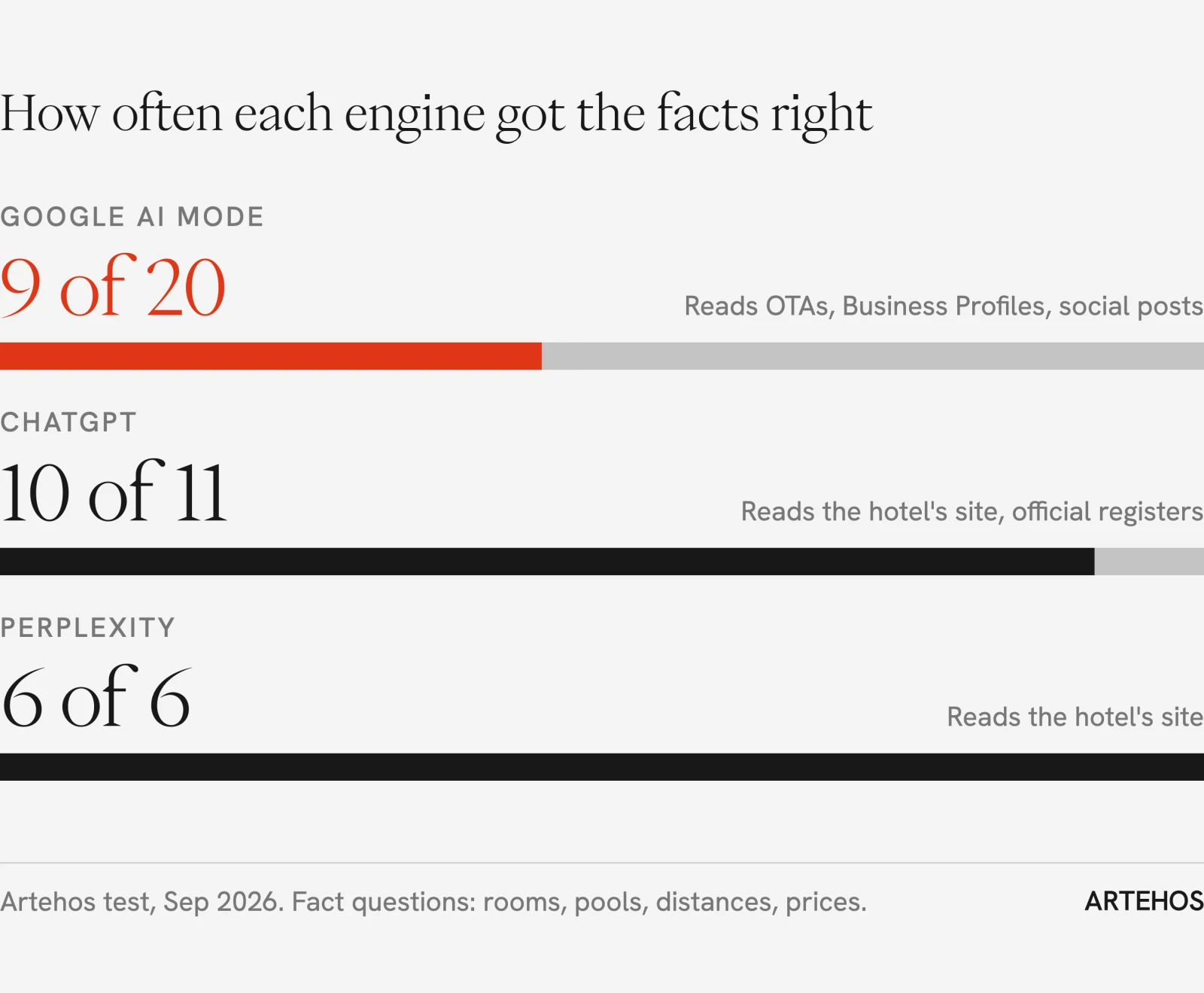
That split matters because the fixes are different. Google's AI features run on the same index and ranking as normal search, and Google says there are "no additional requirements to appear in AI Overviews or AI Mode". In practice that makes your Business Profile, your OTA listings and what other sites say about you the raw material. ChatGPT's search leans heavily on Bing (Seer Interactive found 87% of ChatGPT search citations matched Bing's top 10, a small sample but a clear direction) and then reads your pages directly. One engine punishes a messy Business Profile. The other punishes a website that never states the facts.
The Las Vegas pool is the clearest example of what nobody on property will ever see. The Mulia's pools have ordinary names (Oasis, Courtyard, Aqua), two of them appear as their own places on Google Maps in Bali, and the Oasis Pool does not. So when AI Mode reached for a map card, it grabbed the best-known Oasis Pool it could find, which is 14,000 km away. It isn't the hotel's fault. The hotel is the one it costs.
The same fact, four answers
SOF never states its room count on its own website. The answers filled the gap for it.
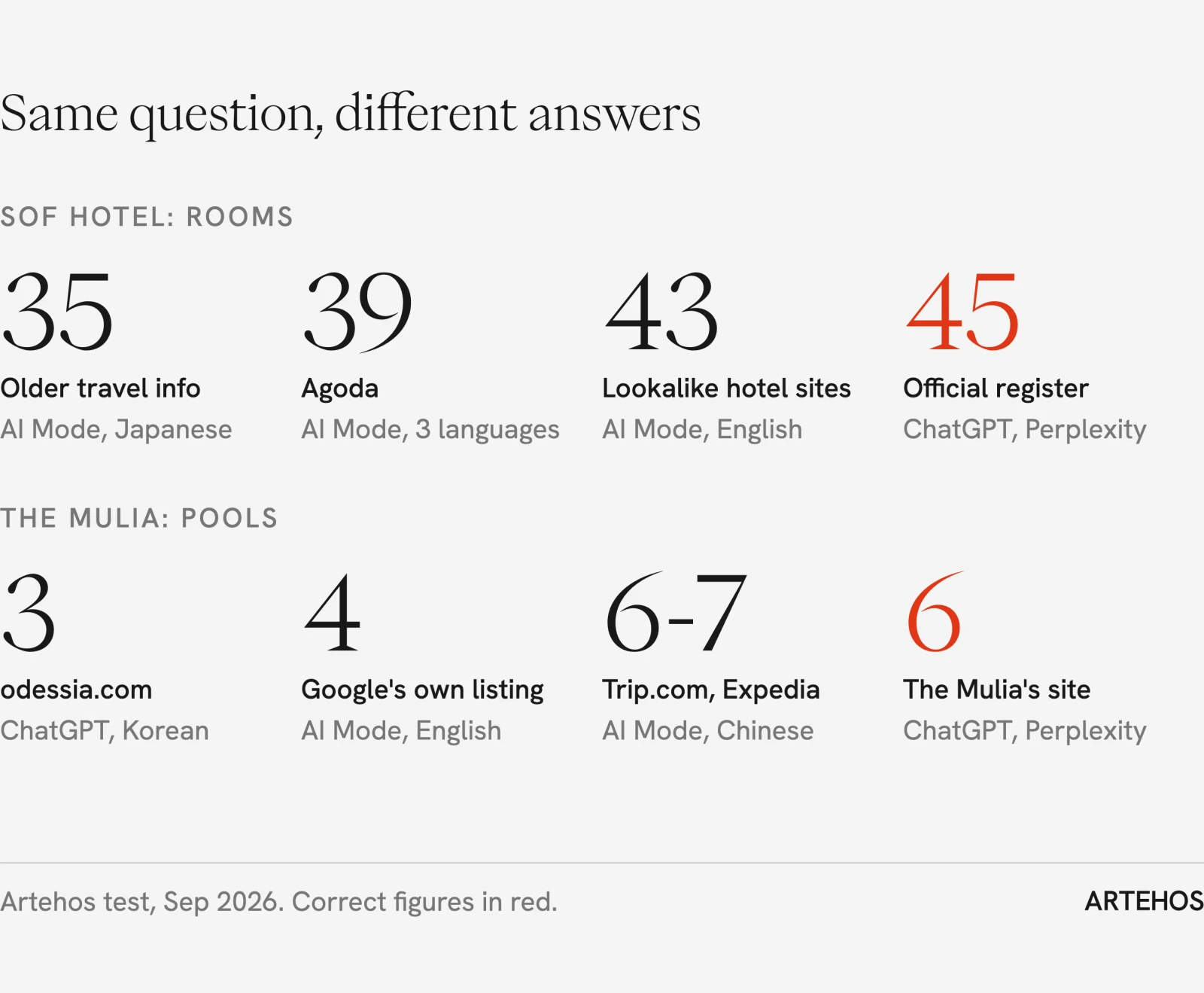
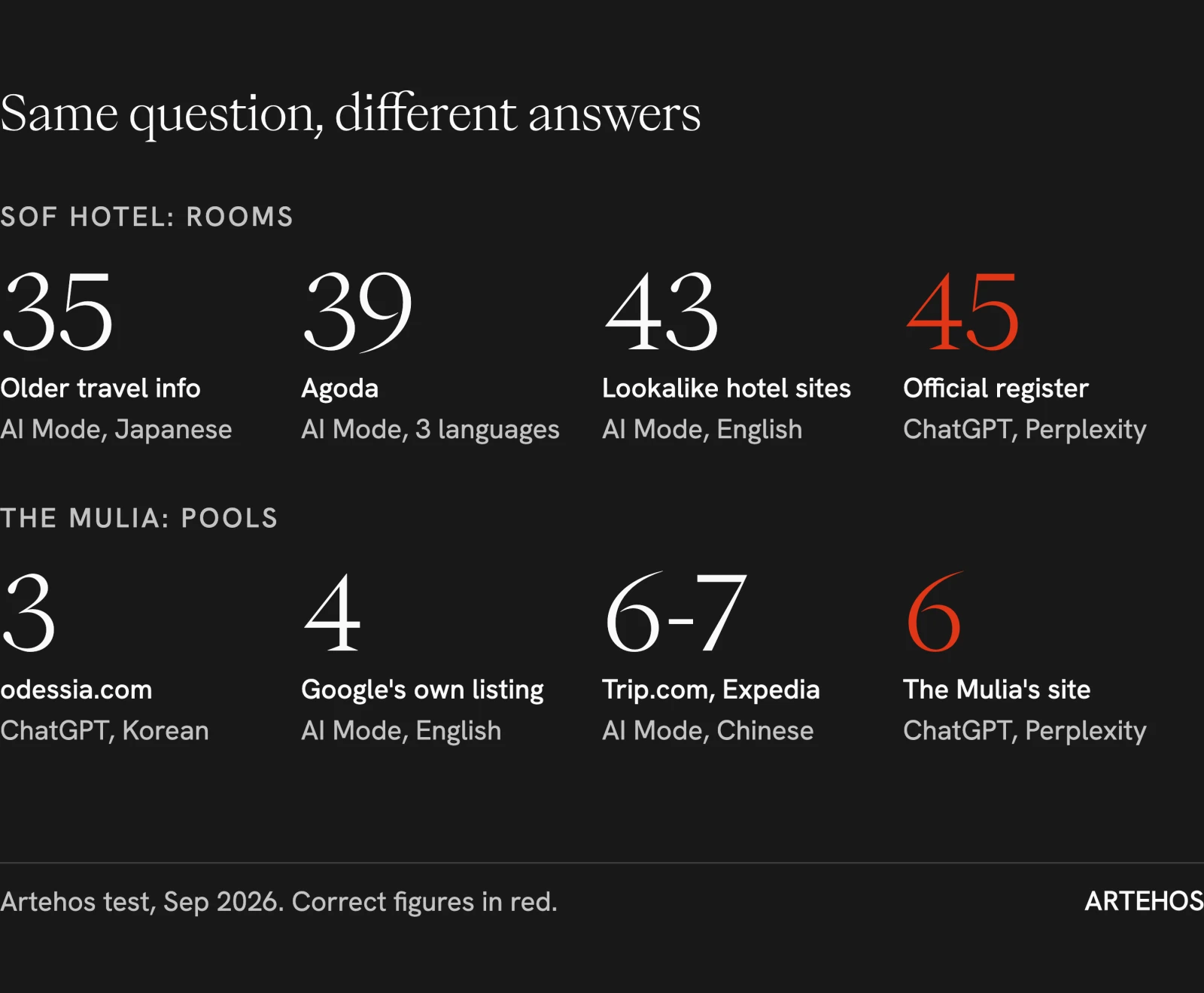
The correct number, 45, came from a government database, not from the hotel. Agoda's "just 39 thoughtfully designed rooms" became the answer in three languages on the engine most travelers already use. If you don't publish a fact in plain text, someone else will, and the engine will pick whichever version it reads first.
Being recommended is a lottery (you can load the dice)
Ask the same question twice and you often get a different hotel. We repeated every discovery question on Google AI Mode two or three times: in 5 of 18 questions the hotel was named in one run and gone in the next. ChatGPT put The Mulia first for an English honeymoon question, then seventh out of nine in a fresh chat the next day.
Location moves it too. Perplexity recommended SOF first for a Japanese "stylish weekend" question asked from Singapore and left it out entirely when we asked from Tokyo. ChatGPT ranked The Mulia fifth for a Korean "best in Nusa Dua" question from Singapore and second from Seoul.
We are not the only ones seeing it. Lighthouse ran 4,545 ChatGPT prompts across nine destinations (June 2026) and found ChatGPT mentioned only 10% of Tokyo's hotels at all; its write-up puts it bluntly: "AI invisibility is the default condition for most hotels." Lighthouse sells hotel data, so read the framing with that in mind; the prompt counts are its own. So a one-off "AI visibility audit" screenshot tells you very little. A fixed set of questions asked every month, in each language, tells you whether you are gaining ground.
The question decides more than the hotel
The most useful thing the test showed was which questions each hotel owns. SOF was named in 21 of 24 answers to "design hotel near Taichung Station", across every engine and language: its location, its architecture and its reviews line up exactly with that question. It was named less often for "best boutique hotel", where Perplexity preferred smaller hotels whose own websites describe them clearly.
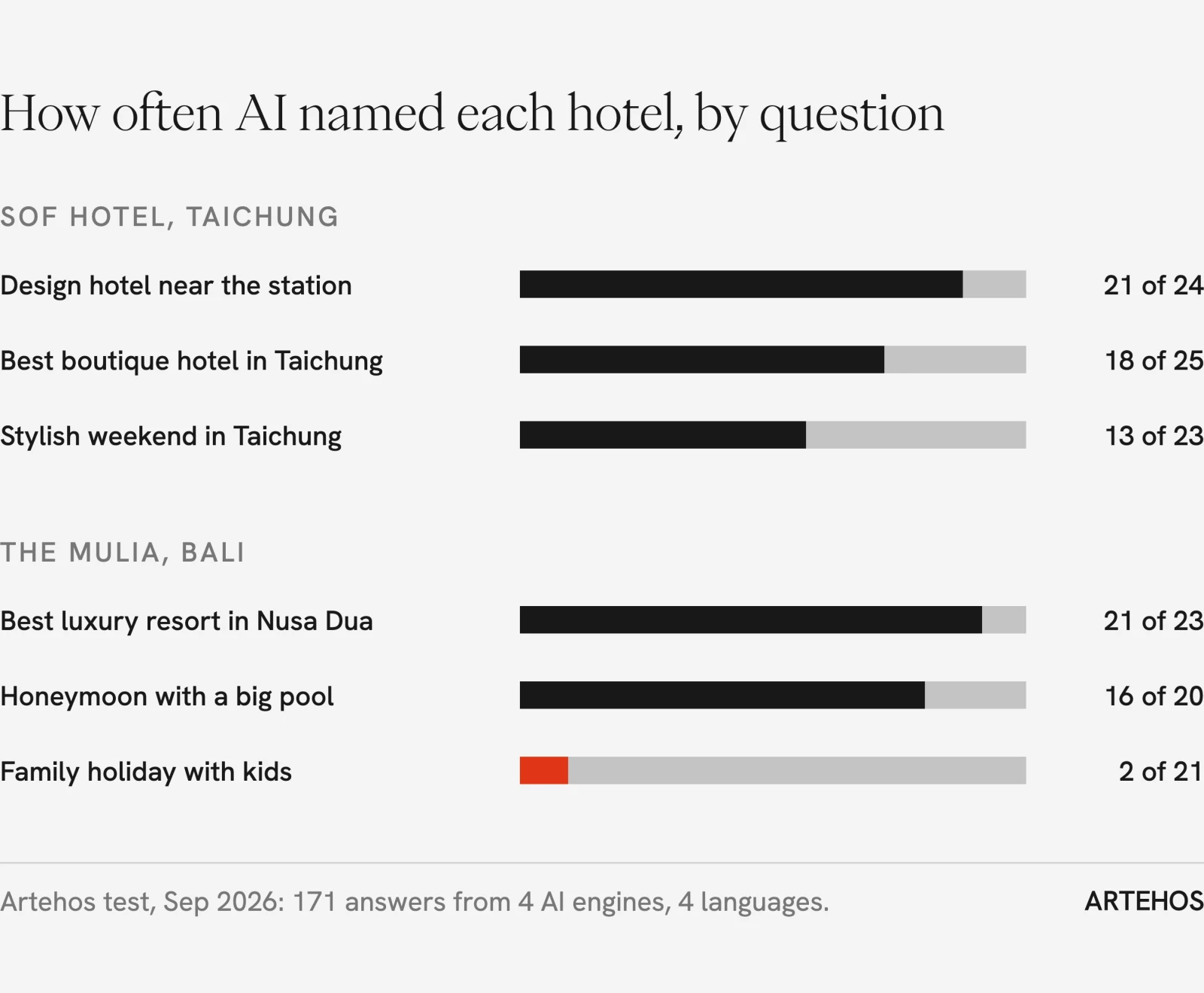
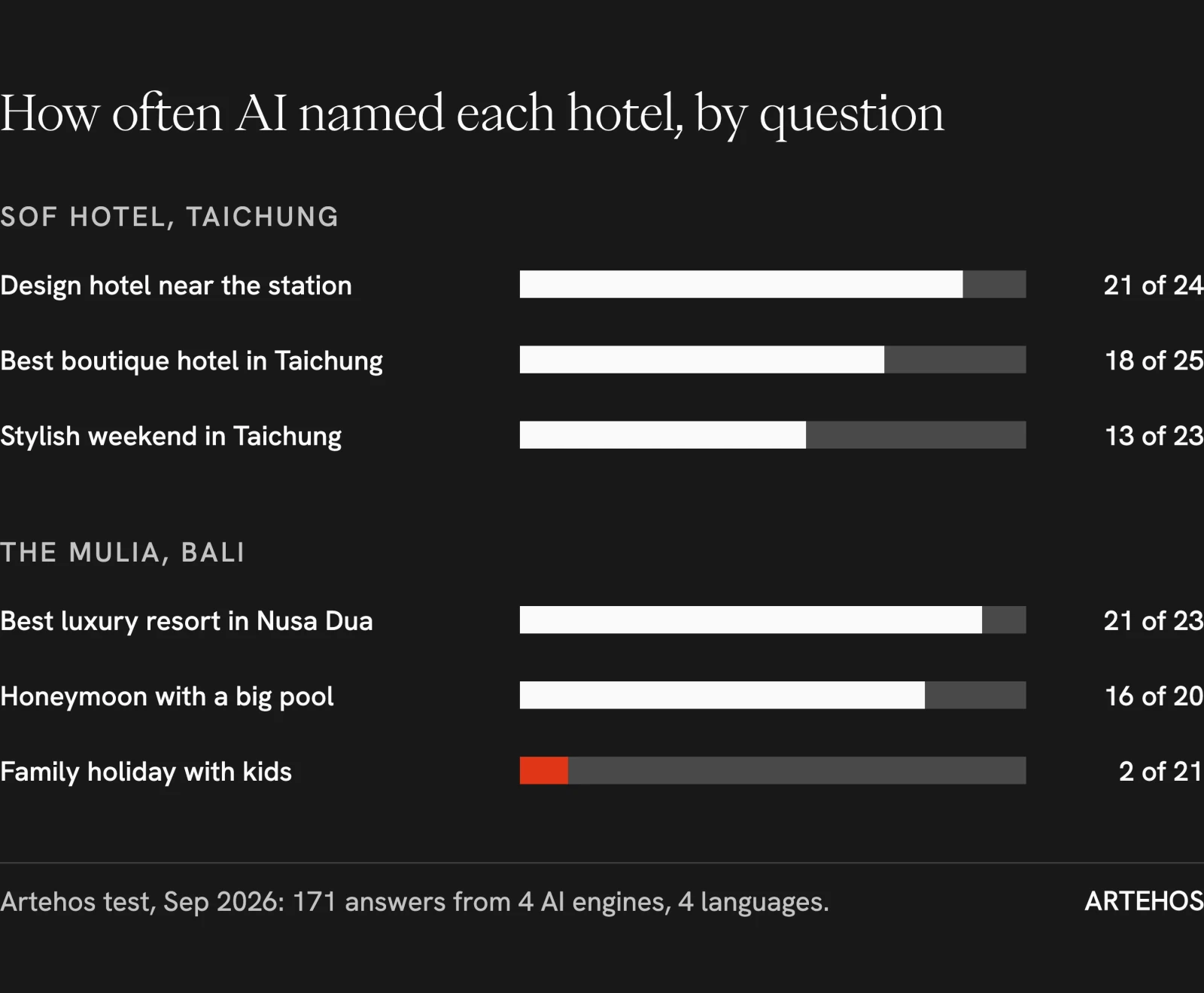
The Mulia showed the reverse. It was named in 16 of 20 honeymoon answers and 21 of 23 "best in Nusa Dua" answers. For "5-star beachfront resort for a family holiday with kids" it appeared in 2 of 21, and never on ChatGPT or Perplexity, although it has a kids' club and a children's pool. The engines recommended the resorts whose pages, reviews and listings talk about families. This one's don't, loudly enough.
The default most hotels hold is "we rank well on Google, so AI will find us." It will find you for the questions your content already answers. For the others you are invisible, and ranking doesn't change that.
Your guests don't ask in English
Language changed which hotels got recommended. The Mulia has Chinese pages on its own site, and Google AI Mode quoted them in its Chinese answers; in English it never cited The Mulia's site at all. SOF has an English and a Traditional Chinese site and no Japanese or Korean pages, so in those languages its story is told by other people: Japanese travel blogs, Naver Blog posts in Korean, Booking.com and Agoda. They mostly tell it kindly. They also told Korean readers the rooms cost less than half the real price.
This is where a multilingual site stops being a nice-to-have. A Korean page that states your rooms, rates, facilities and distances in Korean gives every engine a first-hand source in the language the guest asked in. (We compared how Webflow and WordPress handle languages in an earlier article.)
Google now books rooms inside AI Mode, and independents weren't invited
On 27 August 2026 Google started taking hotel bookings inside AI Mode in the US, in English, with ten launch partners: Booking.com, Choice, Expedia, Hilton, Hotels.com, IHG, Marriott, Priceline, Trip.com and Wyndham (Skift). No independent hotel is on the list. It isn't live in Asia yet, but it shows where Google is heading and whom it chose to go there with. Tim Peter, founder of the hotel digital consultancy Tim Peter & Associates, put it plainly on his blog in September: "Google chose not to connect with them. They chose gatekeepers instead." His conclusion is the one we'd give a GM too: "connectivity gives you a chance to be seen. Brand gets you business."
For an independent in Bali or Taichung, that makes the next two years simple to describe. The engines will increasingly answer and book on behalf of the guest, and they will do it from whatever they can read about you. The OTAs will be readable. The question is whether you are.
What to fix first
If your own site doesn't state your room count, pool count, distances, check-in times and starting rate in plain text, fix that first. ChatGPT and Perplexity will quote you; Google will at least have the right version to find.
If a guest segment matters to you (families, weddings, long stays), give it its own page with the facts that segment asks about. The Mulia is losing family questions it should win.
If your guests come from Korea, Japan or China, publish those facts in their language on your own site before anything else on this list. Otherwise the job goes to bloggers and OTAs.
If your Google Business Profile, your OTA listings and your site disagree on a number, make them agree. AI Mode picks whichever it reads first, and it read Agoda.
If your facilities have ordinary names, use your hotel's name with them ("the [Hotel] beach pool") on your site and profile, and check whether they exist as places on Google Maps under your address.
If someone offers to write you an llms.txt file, ask them for the server logs showing an AI engine requested one. Ahrefs checked 137,000 domains and found 97% of llms.txt files got zero requests. If they pitch schema markup as the AI lever, Ahrefs' before-and-after study found no meaningful effect on AI citations. Keep schema for search results; don't pay for it as an AI strategy.
How to tell if it's working
AI still sends a small share of traffic: Lighthouse puts it at just under 1% of hotel website visits (July 2026). The case today is about being in the answer at the moment a guest decides. Three things to set up: a GA4 channel group that separates ChatGPT, Perplexity, Gemini and Copilot referrals from the rest; Search Console and Bing Webmaster Tools, verified (ChatGPT leans on Bing, and Bing now reports AI citations); and a list of ten questions your guests would ask, in each of their languages, run every month and written down. That last one is the only measure that shows what the engines actually say about you. It is also the one almost nobody has.
This is part of the SEO and AI search work we do for hotels. If you'd like to know what the engines say about yours, send us one question your guests would ask. We'll run it in four languages and show you the answers.